

Singapore accounting firms are under real pressure right now. IRAS compliance requirements have grown more complex, GST-registered businesses are navigating ongoing changes, and clients expect faster turnaround at the same or lower cost. Meanwhile, finding and retaining qualified bookkeeping and accounting staff remains one of the hardest operational challenges for small to mid-sized practices.
AI tools for Singapore accounting firms are not a solution to all of this. But they do address the part of the problem that’s most solvable: the volume of repetitive, manual work that takes up staff time without adding client value.
This guide covers which AI automation tools are most relevant for accounting firms operating in Singapore, how they fit the local compliance and software landscape, and where the highest-value starting points are.
Why AI Automation Matters More for Singapore Accounting Firms Right Now
The Singapore accounting market has a few characteristics that make AI adoption particularly valuable compared to other markets.
Staff costs in Singapore are high relative to most of the region. Any workflow that can be handled automatically rather than manually has a direct cost saving that compounds over time. For a firm paying Singapore salaries, recovering five hours of admin per staff member per week has a meaningful financial impact.
The majority of small and mid-sized accounting firms in Singapore are already using cloud-based accounting software. Xero is widely used, particularly among firms serving SMEs. QuickBooks Online has a significant presence. This matters because the leading AI automation tools integrate natively with both platforms, meaning the infrastructure for automation is already in place for most firms.
IRAS compliance, GST filing, and the associated documentation requirements create recurring, predictable workflows every quarter and every year. Predictable workflows are exactly what automation handles best.
The AI Tools Most Relevant for Singapore Accounting Firms
Xero with AI Features
Xero is the most widely used accounting platform among Singapore SMEs and the firms that serve them. Its built-in AI categorisation learns from historical transaction data and handles the majority of routine bookkeeping entries automatically. Bank feed reconciliation uses AI matching to suggest transaction matches, reducing manual reconciliation time significantly.
For Singapore firms already on Xero, activating and properly configuring these AI features is the highest-value and lowest-effort first step. No new tools required, no new cost.
Dext (Document Capture and Processing)
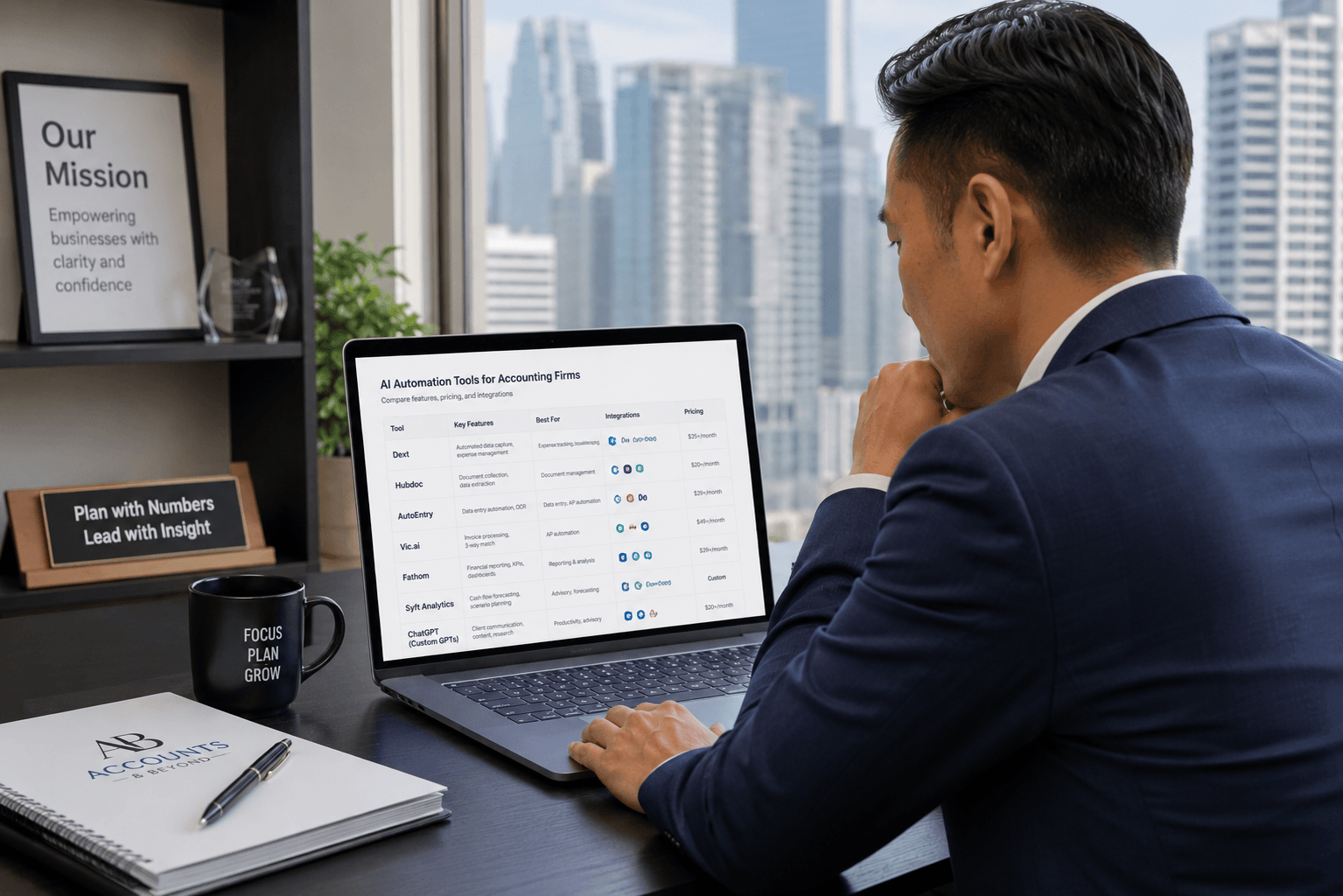
Dext is the leading document capture tool used by accounting firms across Singapore. Clients submit receipts, invoices, and bills via mobile app, email, or upload. The AI extracts supplier name, date, amount, and tax information automatically, then pushes the data to Xero or QuickBooks Online.
For Singapore firms dealing with the volume of receipts and invoices that come with GST-registered clients, Dext removes the manual data entry that currently ties up significant staff time. The accuracy on standard printed documents is high, and the tool integrates cleanly with the accounting platforms most Singapore firms are already using.
n8n (Workflow Automation)
n8n is the automation backbone that connects the tools in a firm’s tech stack and handles the handoffs between them automatically. It is particularly well-suited for Singapore accounting firms for two reasons.
First, n8n supports self-hosting on a local server or Singapore-based cloud infrastructure, which means client financial data does not have to pass through offshore servers. For firms handling sensitive client data and concerned about data residency, this is a meaningful advantage over platforms that only offer cloud-hosted versions.
Second, n8n connects to virtually every tool an accounting firm uses: Xero, QuickBooks Online, Google Workspace, TaxDome, Karbon, Slack, WhatsApp Business API, and more. Singapore clients in particular tend to communicate via WhatsApp, and n8n can integrate automated client notifications and document requests through WhatsApp as well as email, which is a meaningful local advantage.
TaxDome or Karbon (Practice Management)
Both TaxDome and Karbon are used by Singapore accounting firms for practice management. TaxDome’s client portal and document collection features reduce the back-and-forth email that most firms still rely on for client communication. Karbon’s collaborative inbox and team workflow tools are particularly useful for firms with multiple staff working across the same client base.
Either platform, connected to n8n for automation, allows firms to build onboarding sequences, document chase-up workflows, and reporting notifications that run automatically without manual intervention.
Google Workspace
Google Workspace is the standard business email and collaboration platform for most Singapore accounting firms. It integrates with every major automation tool and is the natural email layer for automated client communications. Automated reminder emails and onboarding sequences should come from a real staff member’s Google Workspace address rather than a generic system address, both for deliverability and for maintaining the professional relationship with clients.
The Highest-Value Automation Workflows for Singapore Accounting Firms
Given the specific characteristics of the Singapore market, three automation workflows deliver the most immediate return.
GST Filing Deadline Reminders
GST-registered clients in Singapore file quarterly returns. Missing a filing deadline has consequences for both the client and the firm’s reputation. An automated deadline reminder system that sends internal alerts to the responsible team member and client-facing reminders at defined intervals before each deadline removes the risk of manual tracking failures.
The workflow reads upcoming deadline dates from the practice management tool and fires reminders automatically. For recurring quarterly deadlines, it rebuilds the reminder cycle once the current filing is complete.
Invoice Chasing and Payment Follow-Up
Late payment is a universal problem for accounting firms, and Singapore is no exception. An automated invoice chasing sequence connected to Xero sends personalised reminders when invoices pass their due date, escalating through a defined sequence until payment is received or the account manager is flagged to step in.
For firms that currently chase invoices manually, this typically recovers three to five hours of staff time per month while improving average collection time.
Client Onboarding Automation
Singapore accounting firms bring on new clients through a consistent set of steps: engagement letter, NRIC or company registration verification, Xero setup, document collection, and introductory meeting. Automating this sequence ensures every new client goes through the full process consistently, with nothing falling through the cracks during busy periods.
The workflow fires when an engagement letter is signed, sends the welcome email, triggers the document request via the client portal, creates the client job in the practice management tool, and books the onboarding call. The entire sequence runs without manual coordination.
What to Consider When Adopting AI Tools in Singapore
Data residency. Singapore has clear data protection obligations under the PDPA (Personal Data Protection Act). When evaluating any AI or automation tool that handles client financial data, check where data is stored and processed. Tools like n8n that support self-hosting give firms full control over data residency. Cloud-based tools should be evaluated for their data storage locations and compliance certifications.
Integration with existing software. Most Singapore accounting firms are already running on Xero or QuickBooks Online. Any AI tool worth adopting should integrate natively with whichever platform the firm uses, rather than requiring migration or parallel data entry.
Client communication preferences. Singapore clients communicate differently from clients in Western markets. WhatsApp is widely used for business communication, and many clients will respond faster to a WhatsApp message than an email. Automation tools that support WhatsApp Business API alongside email give Singapore firms an advantage in client responsiveness.
Start with one workflow. The firms that get the most from AI adoption are not the ones that try to automate everything at once. They’re the ones that pick the highest-pain workflow, build it properly, and measure the result before adding complexity. For most Singapore accounting firms, that means starting with either invoice chasing or client onboarding.
FAQ
What AI tools do Singapore accounting firms use?
Singapore accounting firms most commonly use Xero’s built-in AI categorisation for bookkeeping, Dext for document capture and receipt processing, and n8n or Zapier for workflow automation between tools. Practice management platforms like TaxDome and Karbon are used for client management and workflow tracking. Google Workspace is the standard email and communication platform that most automation workflows send from.
How can Singapore accounting firms automate their workflows?
Singapore accounting firms can automate their workflows by connecting their existing tools through an automation platform like n8n. Common automations include invoice chasing sequences connected to Xero, client onboarding workflows triggered by engagement letter signing, GST filing deadline reminders, and document collection requests through a client portal. n8n is particularly suitable for Singapore firms because it supports self-hosting, keeping client data on local or Singapore-based infrastructure.
Is AI bookkeeping suitable for Singapore SMEs?
Yes. Most Singapore SMEs that use Xero or QuickBooks Online already have access to AI categorisation features built into their accounting software. For bookkeeping firms serving these clients, enabling AI categorisation, adding a document capture tool like Dext, and automating routine client communications can significantly reduce the time spent on manual bookkeeping tasks. The tools are available, the integrations exist, and the ROI is measurable within one to two billing cycles.
What is PDPA and how does it affect AI tool adoption for Singapore accountants?
The Personal Data Protection Act (PDPA) is Singapore’s primary data protection legislation, governing how personal data is collected, used, and stored. For accounting firms adopting AI tools, PDPA requires that any tool handling client personal data, including financial records and identity information, processes and stores that data in a compliant manner. Firms should check where each tool stores data, review the vendor’s data processing agreements, and consider self-hosted options like n8n where data residency and control are priorities.
Which accounting software do most Singapore firms use?
Xero is the most widely used accounting software among Singapore SMEs and the accounting firms that serve them. QuickBooks Online also has a significant user base. Both platforms have robust AI features built in and support the integrations required for workflow automation. MYOB is less common in Singapore than in Australia and New Zealand, though some legacy users remain.
Getting Started with AI Automation for Your Singapore Accounting Firm
The starting point for most Singapore accounting firms is not buying new software. It’s getting more out of the tools already in use, connecting them properly, and automating the workflows that are currently consuming staff time manually.
Xero’s AI features, Dext for document capture, and a well-built automation layer covering invoice chasing and client onboarding will recover significant hours every month for most practices.
Lenworks is based in Singapore and specialises in building these automation workflows for accounting and bookkeeping firms. We understand the local compliance context, the tools Singapore firms use, and how to build automations that fit how practices here actually operate.
Related reading: How to Automate Your Accounting Firm | Accounting Automation Examples