

Every few months, a new headline declares that AI is about to make accountants obsolete. Every few months, accountants keep working.
The question of whether AI will replace tax accountants and bookkeepers is worth taking seriously. Not because the answer is yes, but because the firms asking it tend to make better decisions about how to adopt AI than the ones dismissing it. This article looks at what AI is actually doing in accounting firms right now, where it genuinely falls short, and what the evidence suggests about the future of the profession.
The Real Question Isn’t “Will AI Replace Accountants?”
Framing this as a replacement question leads to the wrong conclusions. A more useful question is: which parts of accounting work is AI already handling, and which parts does it struggle with?
The answer shapes how forward-thinking firms are positioning themselves. The ones pulling ahead are not the ones that adopted AI earliest. They’re the ones that identified which tasks AI handles well and restructured their workflows accordingly, freeing their people to focus on the work that still requires human judgment.
That distinction matters. Firms that treat AI as a threat tend to do nothing and hope it passes. Firms that treat it as a tool tend to grow faster, serve clients better, and compete more effectively on price and turnaround time.
What AI Is Already Doing in Accounting Firms
Several categories of accounting work are already being handled by AI tools, either fully or with minimal human oversight.
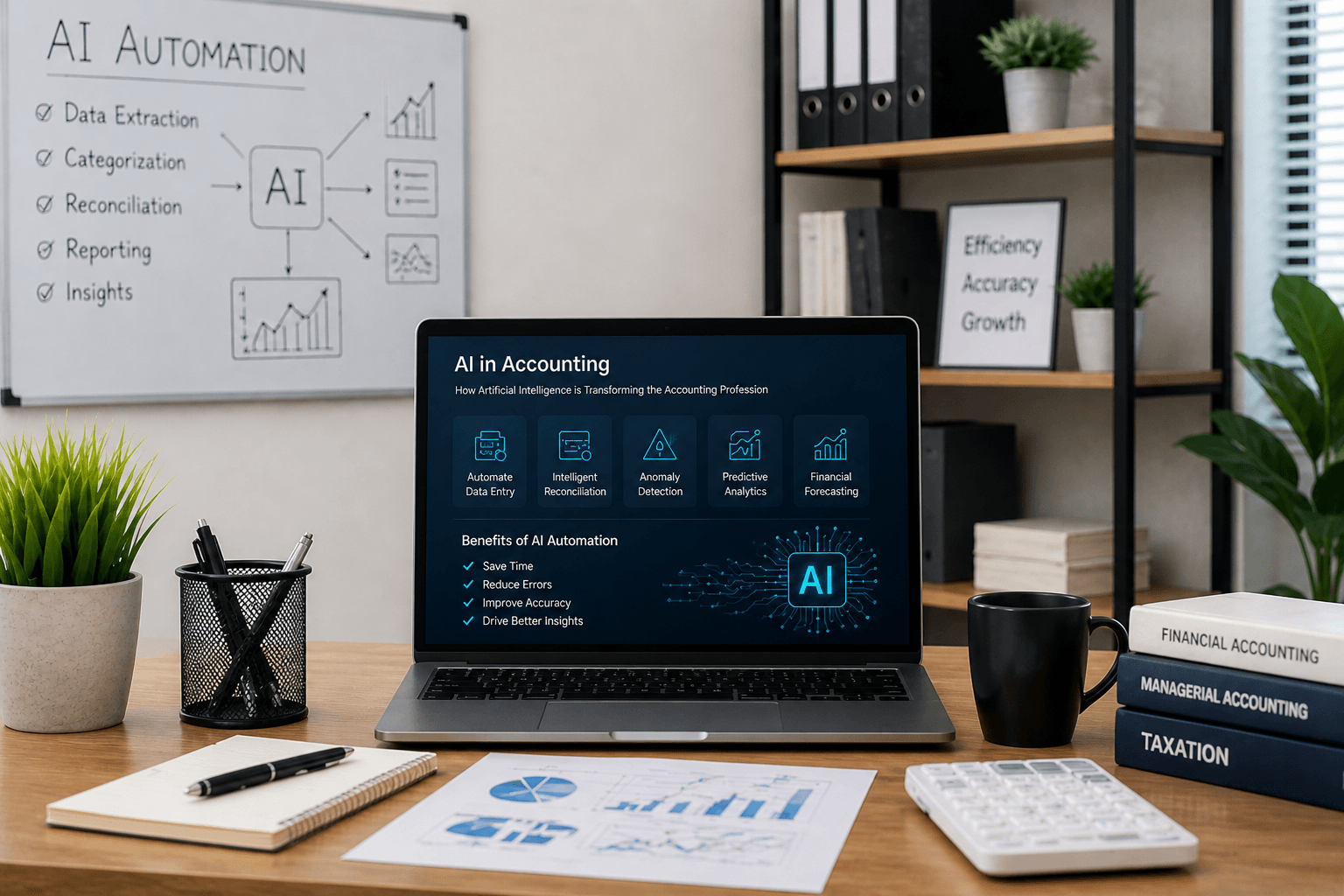
Transaction categorisation. AI bookkeeping tools like those built into Xero and QuickBooks Online now categorise the majority of transactions automatically based on historical patterns and machine learning. For straightforward bookkeeping clients, this reduces manual data entry significantly. The accountant’s role shifts from categorising to reviewing and correcting.
Document processing. Tools like Dext and AutoEntry extract data from receipts, invoices, and bank statements automatically. What used to take an hour of manual data entry now takes minutes of review. The accuracy on standard documents is high enough that human review is a quality check rather than the primary workflow.
Reconciliation. Bank reconciliation has become largely automated in modern accounting software. Xero and QuickBooks Online match transactions against bank feeds automatically, flagging only exceptions that need human attention. A task that once took hours per client now takes minutes.
Report generation. Standard financial reports, including profit and loss, balance sheet, and cash flow, are generated automatically from the underlying bookkeeping data. The AI doesn’t interpret them or advise on them, but it produces them without human involvement.
Compliance monitoring. Some platforms now flag potential compliance issues automatically, alerting accountants to VAT anomalies, payroll discrepancies, or filing deadline risks before they become problems.
The pattern across all of these is consistent. AI handles the structured, rule-based, data-heavy parts of the workflow. The output still requires human review, but the volume of manual work involved has dropped substantially.
Where AI Falls Short in Accounting
The tasks AI handles well share a common characteristic: they follow defined rules and operate on structured data. The tasks AI struggles with share a different one: they require judgment, context, or relationship management.
Advisory work. A client facing a major business decision, whether to take on a lease, restructure the company, or bring on a co-founder, needs advice that weighs their specific circumstances, risk tolerance, and long-term goals. AI can provide general information but cannot replace the judgment of an accountant who knows the client, their industry, and their history.
Complex tax planning. Standard tax returns are increasingly automatable. Complex tax planning for high-net-worth individuals, business structures with multiple entities, or cross-border situations requires expertise that AI tools do not currently replicate reliably.
Client relationships. Clients who are stressed about their finances, navigating a difficult year, or making a significant business decision want to talk to a person. The trust component of the accountant-client relationship is not something a software tool can substitute for.
Exception handling. AI performs well on clean, standard data. When data is messy, incomplete, or involves unusual transactions, human judgment is still required to determine how to handle it correctly. The 20% of cases that don’t fit the standard pattern typically still land on a person’s desk.
Regulatory interpretation. Tax law and accounting standards change constantly. Applying new rules to specific client situations, interpreting grey areas, and making defensible professional judgments in ambiguous cases still requires qualified human expertise.
How Leading Firms Are Using AI to Grow, Not Downsize
The firms that have adopted AI most effectively are not using it to cut headcount. They’re using it to change what their headcount does.
In a traditional bookkeeping firm, a significant portion of staff time goes to data entry, transaction categorisation, and report preparation. With modern AI tools handling most of that automatically, the same staff can manage a larger client portfolio, spend more time on client communication, or move up the value chain into advisory services.
The practical result is that firms using AI well tend to grow revenue per employee rather than reduce employee count. They take on more clients without hiring proportionally, and they offer higher-value services because their team has capacity for them.
Some firms have reduced entry-level headcount as AI handles tasks that used to require junior staff. But the more common pattern is that junior staff spend less time on data entry and more time on review, client communication, and developing the judgment that becomes expertise over time.
The Risk Is Falling Behind, Not Being Replaced
For accounting firm owners, the more pressing concern is not that AI will replace their team. It’s that firms that adopt AI effectively will be able to undercut them on price, turn around work faster, and offer a better client experience, all at the same or lower cost.
A firm processing bookkeeping manually is competing against firms where AI handles most of that processing automatically. The gap in efficiency compounds over time. Clients who find out that another firm can deliver the same output faster and cheaper will eventually notice.
The accountants most at risk are not accountants broadly. They’re accountants at firms that treat AI adoption as optional and continue to compete primarily on manual processing capacity. That’s a position that becomes harder to defend each year.
FAQ
Will AI replace tax preparers?
AI is unlikely to fully replace tax preparers, but it is already automating a significant portion of routine tax preparation work. Standard returns for straightforward individual clients are increasingly handled with minimal human input. Complex tax situations, planning advice, and client relationships still require qualified human expertise. The tax preparers most at risk are those who compete primarily on completing standard returns quickly and cheaply, as AI tools are eroding that advantage.
What accounting jobs are most at risk from automation?
The roles most affected by accounting automation are those focused primarily on data entry, transaction categorisation, bank reconciliation, and standard report preparation. These tasks are increasingly handled by AI tools within accounting software. Roles that involve client advisory work, complex tax planning, judgment-based decisions, and client relationship management are considerably less exposed to automation.
How are accounting firms using AI right now?
Accounting firms are currently using AI for transaction categorisation, document data extraction, bank reconciliation, standard report generation, and compliance monitoring. Tools like Xero, QuickBooks Online, Dext, and AutoEntry have AI features built in that automate large portions of the bookkeeping workflow. More advanced firms are also using AI to automate client communication workflows, invoice chasing, and onboarding sequences through automation platforms like n8n.
Should I automate my accounting firm?
Yes, if you want to remain competitive over the next three to five years. The question is not whether to automate but where to start. The highest-value automations for most accounting firms are invoice chasing, client onboarding, and monthly reporting notifications. These deliver immediate time savings and do not require replacing existing tools. Starting with one well-built automation and expanding from there is more effective than trying to automate everything at once.
Will accounting be automated completely?
No. The structured, repetitive parts of accounting work are already substantially automated and will continue to be. The advisory, relational, and judgment-based parts of accounting are not on a credible path to full automation with current AI technology. The profession will continue to evolve, with accountants spending less time on data processing and more time on the work that requires expertise and human judgment.
What This Means for Your Firm
The evidence does not support the conclusion that AI will replace accountants. It does support the conclusion that accounting work is changing, and firms that adapt early will have a structural advantage over those that wait.
The practical starting point for most firms is not grand AI strategy. It’s identifying the three or four most repetitive, time-consuming tasks in your current workflow and building automations to handle them. That alone frees up enough capacity to see the difference clearly.
If you want help identifying where automation can have the most immediate impact in your accounting firm, that’s what we do at Lenworks.
Related reading: How to Automate Your Accounting Firm | Accounting Workflow Automation: A Practical Guide